

The Rules of Perspective, or Why the Rails Converge at the Horizon

Updated: Mar 25
When you stand next to a railway track and look into the distance, the two rails, perfectly parallel in reality, appear to drift closer together until they meet at a single point on the horizon (Fig. 1). This illusion is one of the most intuitive examples of perspective. In this post, we explore why objects appear smaller as they recede into the distance, starting with how our vision works and finishing with spatial geometry that governs this phenomenon.

How Our Vision Is Bounded by Angles
Our eyes are windows to the world. The area you can observe without moving your eyes is known as the visual field. Everything you see must fit within this window. What lies outside this range is beyond your reach. To view those regions, you must shift your gaze, much like moving to a different window to see what’s happening on the other side of a building.

For a single human eye, the field of view spans about 150° horizontally and 120° vertically. When both eyes are used together (binocular vision), the total horizontal field expands to around 200° (Fig. 2). For simplicity, however, we will focus on one eye.
Only a small central region, located inside the macula, is sharp and detailed. The rest is lower resolution but still contributes to our sense of space. Everything you see, whether close or distant, must fit within a restricted angular field of 150° horizontally and 120° vertically for a single eye.
How Vision Projects the 3D World Onto the 2D Retina
We see the world because light carries information about objects into our eyes. Light passes through the pupil and stimulates the photoreceptors in the retina (Fig. 3). Because the retina is a two-dimensional layer of photoreceptors, we perceive the world as a three-dimensional space projected onto a two-dimensional surface. The sense of the third dimension, depth, referred to as perception, arises from the angles at which light strikes the retina.
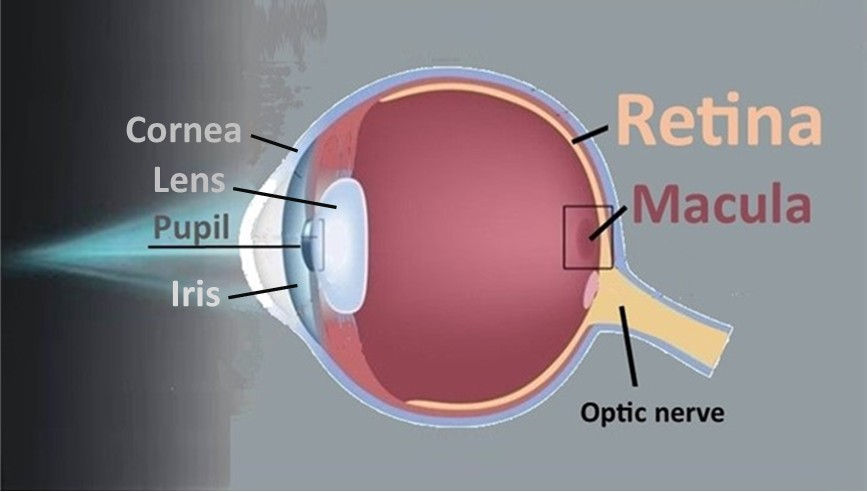
The size of the retina determines the span of the visual field. If you draw a line from the macula through the pupil, it will lead you to the spatial region in front that marks the center of the visual field (the macula region in Fig. 2. Lines drawn from the edges of the retina lead to the fringes of the visual field, marked as far peripheral zones. The perceived size of an object within the field is determined by the size of its projection on the retina.
From Real Size to Angular Size
Imagine a conifer tree positioned before you (Fig. 4). As you approach, the tree appears to grow in size because it subtends a larger angle in your visual field, which corresponds to a larger area on your retina. As you move closer, the tree begins to dominate your view, pushing all other objects out of it. Eventually, the tree outgrows the span of your visual field, with the top beginning to vanish into the blind zone.

In contrast, moving away from the tree reduces the angle it subtends, allowing more of the surrounding environment to enter your view. The farther away you move, the smaller this angle becomes. As the distance increases, the angle approaches zero, and objects begin to appear as dots. Objects appear smaller because they occupy smaller areas on your retina.
Fixed Size vs. Fixed Angle: the Geometry of Perspective
The law of perspective arises from the geometry of space. Space is a challenging concept that often leads to confusion and misconceptions. Even though we live within it, its properties can be surprisingly difficult to grasp. Just think of this intriguing feature: objects appear to shrink with distance precisely because they keep their sizes unchanged.

We perceive an object's size based on the angle it occupies in our visual field, which leads to a paradox. For an object to appear the same size regardless of distance, it would need to maintain a constant angle (Fig. 5, left). This would require the object to physically shrink as we approach it and expand as we move away.
In reality, however, an object’s size is fixed. Instead, the angle is changing, making the object appear to change size (Fig. 5, right). This is the essence of perspective. The apparent change in size gives us a sense of depth, helping us gauge how close or far the object is.
When Angle Stays Unchanged: The Case of a Rainbow
Physical objects must comply with the rule of perspective. Optical phenomena, however, can behave differently because they do not exist as solid objects with a fixed size. Nonetheless, both physical objects and optical effects obey the same underlying geometry of space. A rainbow provides a striking example of a case where the angle remains fixed while the size increases with distance. A three-dimensional illustration of this idea is shown in Fig. 6.

A rainbow is defined by an angle of about 42° for the primary arc. This angle remains constant for the observer, causing the rainbow to expand outward in space. What we perceive as a two-dimensional arc in the sky is, in fact, a three-dimensional cone extending from the observer’s eye. Because the angle is fixed, the cone must grow larger with distance. Unlike physical objects, which shrink in angular size as they recede, the rainbow maintains its angular size and instead increases its spatial extent. As a result, it lacks the usual cues of perspective.
Imagine standing in an open field during the rain. If raindrops extend all the way to the horizon, which is about 5 km (3 miles) away, the rainbow begins at your eye and expands toward the horizon. Using simple geometry, we can calculate its diameter at that distance, reaching about 9 km (5.6 miles).
What appears to us as a flat arc suspended in the sky is actually this vast cone stretching away from our eyes into the third dimension. We do not perceive the rainbow's depth because the constant angle removes the visual cues that normally signal the outward distance. In this sense, a rainbow offers a glimpse of what the world would look like without perspective.
Returning to The Rails
Perspective does not distinguish between objects and the gaps between them. As a result, perfectly parallel rails appear to converge at a distant point. The paradox remains: for the rails to appear parallel, they would have to occupy a constant angle in our visual field, which means they would have to physically drift apart. Such a track would be impractical, but the visual effect would be striking. The rails would seem eerily parallel all the way to the horizon.
A short walk along the rails, however, would quickly break the spell, revealing their true geometry. We can create illusions that challenge our intuition, but we cannot alter the underlying structure of nature. All visual effects, whether perspective or a rainbow, depend on the observer’s point of view. The laws of nature, however, remain independent of any observer. It is this distinction that lets us see through illusion and recognize the deeper order of the world.




Comments