

Geostationary orbit: why satellites can stay still in the sky
- Physics Core

- 4 hours ago
- 6 min read
If you could see as far as 35,786 km (22,236 miles) above Earth, you would observe an impressive parade of satellites forming a fixed arc in the sky (Fig. 1). By moving to a pole and rising high above it to see past Earth’s curvature, you would realize that this arc is part of a full ring of hundreds of satellites, all maintaining a constant position. This family of satellites occupies a unique region in space known as geostationary orbit. Satellites in this orbit move around Earth at the same rate that Earth rotates on its axis. This synchronized motion keeps them stationary relative to Earth's surface, an advantage widely used in telecommunications.

Geostationary satellites coverage
You likely have a satellite dish at your home that offers satellite TV or Internet services. This dish points to the same spot in the sky because the geostationary satellites appear motionless. Satellites use electromagnetic signals for communication. Likewise, our vision relies on electromagnetic signals, only in the visible spectrum. All electromagnetic waves travel in straight lines. So if a satellite is in your line of sight, you are in its line of sight as well. This common characteristic helps explain how a geostationary satellite keeps a constant "eye-to-eye" connection with antennas.
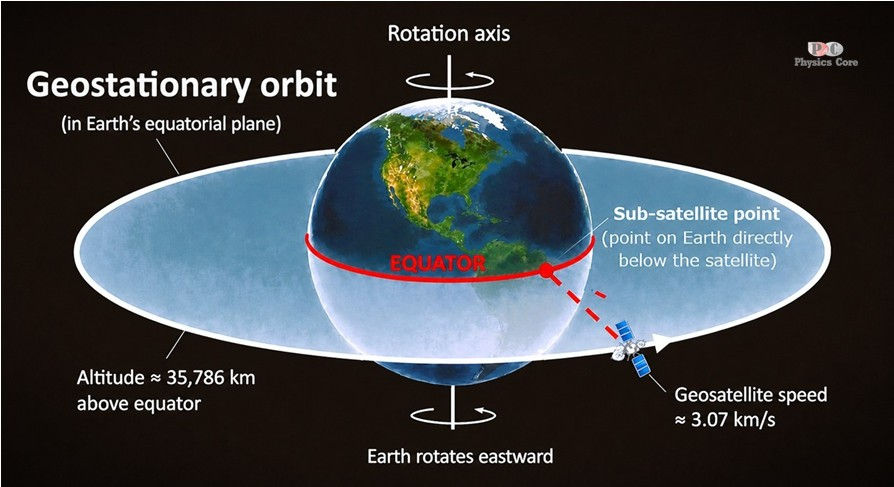
When we observe geostationary satellites from a vantage point high above a pole, we gain a panoramic view of the entire ring (Fig. 2). However, as we descend to ground level, the satellites disappear behind Earth's curvature. If a satellite is not within our line of sight, it can't establish a direct path to us either because electromagnetic waves travel in straight lines and cannot bend around Earth. This simple geometry explains why geostationary service is not available at the poles.
Even in nearby regions, where satellites appear along the horizon, their signals travel at very low angles, passing through more atmosphere and obstacles, which can significantly degrade reception. While polar regions can still be observed by satellites in different orbits, those satellites do not remain over the same region. The unique properties of geostationary orbit can't be replicated in other orbits, so ground-based antennas in those regions must continuously adjust their pointing to track moving satellites.
Why satellite dishes stay fixed
Except for regions near the poles, geostationary satellites provide coverage almost worldwide. As you move from a pole toward the equator, you notice the arc of geostationary satellites appearing on the horizon. Moving further on, you observe the arc rising in the sky until it reaches its highest point when you arrive at the equator. At every point along your journey, if you pause, the satellites remain stationary relative to you. This is the feature that makes the geostationary orbit so special.

You can imagine a straight line connecting your eyes to the nearest satellite, whose signal follows the shortest path to your location. A satellite dish uses the same line to capture the satellite's transmission (Fig. 3). As you stand on the ground, with a satellite in your view, you receive its signals. Although we cannot see them because they lie outside the visible spectrum, antennas are specifically designed to detect the radio frequencies used for satellite communication.
The physics behind geostationary orbit
The geostationary orbit lies in Earth's equatorial plane, directly above the equator (Fig. 2). This plane has a unique property: in addition to passing through Earth's center, as all orbital planes must, it is also perpendicular to Earth's rotation axis. Because of this geometry, the plane divides Earth into two equal hemispheres that rotate as mirror images of each other. Its special role is illustrated by the Foucault pendulum. At the equator, the direction in which the pendulum swings stays fixed, whereas at other places, the direction gradually rotates.
As the Northern and Southern hemispheres are mirror images of each other, your journey from the equator to the South Pole will repeat the pattern described. As you travel from the equator toward the opposite pole, you notice the arc descending behind you, touching the horizon, and disappearing beyond the Earth's curve. Along the way, satellites appear at different angles above the horizon, depending on your latitude. However, when you stop at any location, that viewing angle remains fixed. Consequently, once a satellite dish is properly aligned, its pointing direction remains constant, eliminating the need for further adjustments.
The unique ability of geostationary satellites to remain fixed relative to Earth’s surface has inspired bold futuristic ideas, such as the space elevator and the analemma tower. Both concepts rely on structures extending tens of thousands of kilometers into space, highlighting the immense distance to geostationary orbit and the formidable engineering challenges involved. But why does it have to be so distant? Could we bring it closer to Earth? The answer lies in the relationship among gravity, speed, and orbital period.
There are countless possible orbits around Earth. A satellite can occupy any of them, provided its speed balances the gravitational pull at that altitude. Gravity is strongest near Earth and weakens with distance. As a result, satellites must move faster at lower altitudes, where gravity is stronger, and slower at higher altitudes, where gravity is weaker.
For instance, the International Space Station (ISS), which orbits Earth at an altitude of 420 km (261 miles), experiences a stronger gravitational pull than a geostationary satellite. To remain in orbit, it must travel at a much higher speed, completing almost 16 orbits while Earth completes one rotation. Consequently, instead of remaining still relative to the location beneath it, the station passes over it 16 times in 24 hours. On the ground, a satellite dish would need to continuously adjust its position to track the station as it moves across the sky.

In contrast, the Moon, our natural satellite, is much farther away than a geostationary satellite, orbiting Earth at an average distance of 384,400 kilometers (238,900 miles). It experiences a much weaker gravitational pull and balances it with a significantly slower orbital speed. As a result, the situation reverses: Earth rotates about 27 times, while the Moon completes just one orbit. If the Moon were used for telecommunications, satellite dishes would need to continuously track its motion across the sky, much as they would for the ISS, though at a far slower rate.
The geostationary orbit is unique
Between these two extremes lies the geostationary orbit, located at an altitude of 35,786 km (22,236 miles). At this distance, gravity is balanced by an orbital speed of about 3.1 km/s, allowing a satellite to remain in synchronous orbit with Earth's rotation.
The geostationary orbit is unique because it satisfies all the conditions required for a stable circular orbit while matching Earth's rotational period. The relationship among orbital radius (r), speed (v), and orbital period (T) is expressed by two equations shown in Fig. 4. One equation describes how a satellite's orbital speed decreases as the distance from Earth increases, while the other relates orbital speed to orbital period. Together, they determine the single altitude at which a satellite completes one orbit in exactly 24 hours.
Stationary orbits around other planets
Stationary orbits exist around all rotating celestial bodies, whether moons, planets, or stars. Their altitudes depend on the body's mass and its rotational period. Yet the underlying principles remain universal, making stationary orbits as unique to other worlds as the geostationary orbit is to Earth. Because planetary masses and rotation rates vary greatly, the resulting stationary orbits can differ dramatically from one world to another.
Venus provides a striking example. Although its mass is about 20% lower than Earth's, which would, by itself, bring the stationary orbit closer to the planet, its extremely slow rotation has the opposite effect and dominates the outcome. Venus rotates both slowly and in the retrograde direction, completing one rotation in about 243 Earth days. The backward rotation itself does not fundamentally change the physics of a stationary orbit, since a satellite only needs to orbit in the same direction as the planet's spin.
The long rotational period, however, changes everything. To remain synchronized with Venus, a satellite must orbit much more slowly than one around Earth, placing it much farther from the planet. As a result, the Venus-stationary orbit lies roughly four times farther away than Earth's geostationary orbit.
Such an orbit would be too distant for detailed surface observations. However, it could still serve as a valuable communications location or as a future staging point for Venus exploration.


Comments