

Galilean relativity: from absolute rest to relative motion

Updated: Apr 30
In 1632, Galileo Galilei presented his theory of relativity in Dialogue Concerning the Two Chief World Systems. At the time, our understanding of the universe was undergoing a profound transformation from the geocentric system of Claudius Ptolemy, which had dominated for nearly 2,000 years, to the heliocentric model proposed a century earlier by Nicolaus Copernicus. This shift demanded a fundamentally new way of thinking about motion and the very notion of absolute rest.

Major shift in how we perceive the universe
The geocentric system placed Earth at the center of the universe, with the Sun and planets revolving around it. This central position implied that Earth was in a state of absolute rest, an idea that seemed consistent with everyday experience. Motion typically causes muscles to strain as it knocks us off balance. Yet when standing on the ground, we feel totally relaxed. If that is not rest, then what is? Also, if Earth were moving, wouldn’t everything be flung behind? Yet when we throw a ball straight up (Fig. 1), it returns to the very spot from which it was launched. How can this be, if the Earth itself is in motion?
To reconcile telescopic observations with everyday experience, a new set of physical concepts was required. The heliocentric model displaced Earth from its central position, and with it went the point in the universe associated with absolute rest. While Nicolaus Copernicus retained Aristotle’s view that this point was essential for describing motion, Galileo took a radically different approach, arguing that all motion is relative and no universal rest frame is necessary.
Galileo's thought experiment
Galileo was motivated by his famous thought experiment. He imagined himself inside a cabin on a smoothly sailing ship. In the absence of bumps and jolts, would he even notice that the ship was moving? If he threw a ball straight up, would it land behind him because the ship moved forward? Would any object or living creature behave differently in the cabin compared to how they behave on stationary land? If not, why should we require a specific, universally accepted frame of rest to describe behavior that is essentially the same?
When a ship glides smoothly through the water, we remain unaware of its motion because we are part of a closed system in which everything shares the same velocity. We can only detect this motion by looking outside the system, for example, by watching the shoreline pass by. In this sense, Earth is our ship, carrying us smoothly through space. Because we move along with it, its motion isn't immediately apparent to us. The new perspective was revealed when Nicolaus Copernicus compared Earth with other planets and recognized that, just like them, it moves around the Sun.
Galilean relativity
Galileo could have taken the Sun as a new reference for absolute rest. Instead, he made a more radical move and discarded the concept altogether. We perceive Earth as stationary because it moves through space uniformly. Such motion produces no change in how physical laws appear to us within our closed system. So why should we abandon the idea that Earth is at rest, if uniform motion is indistinguishable from it? Following this insight, the principle of Galilean relativity can be formulated as:
The laws of physics are the same in all systems moving with constant velocity, including those at rest
Galilean relativity replaced the notion of an absolute rest frame with a local rest frame. This type of frame can be assigned to any system moving uniformly, with all other systems described as moving in relation to it. We apply this approach to Earth, considering it stationary within its own closed system. This perspective allows us to accurately describe motion using standard physical laws, while retaining our method of measuring speeds relative to the ground.
Introduction of inertia and friction
This new concept marked a sharp departure from Aristotle's views, which had prevailed throughout the geocentric era. He held that motion and rest are fundamentally different states: motion requires a continuous cause, and when that cause is removed, a body naturally comes to rest. However, this perspective could not explain why a ball continues to move with the ship even while airborne, or why Earth shows no signs of revolving around the Sun, causing everything on it to behave as if it were at rest.
To address this inconsistency, Galileo proposed a radically different view: motion does not require an external cause to continue. Instead, it tends to persist naturally. This shift led to the concept of inertia, the tendency of all bodies to remain at rest or in uniform motion unless influenced by an external factor. On Earth, motion dies out because friction gradually slows it down. Thus, Galileo recognized that friction masks the true nature of motion. In the absence of such resistance, bodies like Earth naturally maintain uniform motion over time.
From Galileo to Newton and Einstein
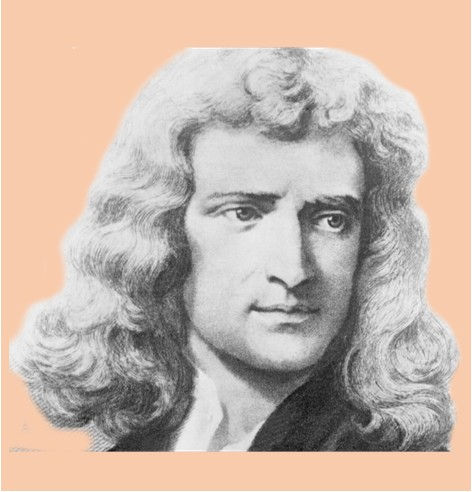
Galileo Galilei stopped short of developing the idea of inertia into a formal law embedded in a broader framework. This task was taken up and completed by Isaac Newton, who, in his Three Laws of Motion, identified force as the cause of changes in motion. The First Law formalizes inertia as follows:
A body remains at rest or moves at a constant speed in a straight line unless acted upon by a net external force.
In essence, this law identifies force, F, as what causes a body to deviate from uniform motion. The Second Law makes this idea quantitative by relating force to the rate of change of momentum, mv, where m is the mass of a moving body and v its velocity. For constant mass, this means that force is proportional to the rate of change of its velocity, or what we now call acceleration, a. This leads to the familiar equation, F = ma.
The Third Law highlights the mutual nature of interactions: when one object applies a force on another, the second object applies an equal and opposite force on the first. No object can affect another without being affected in return. Thus, Galileo determined that uniform motion is relative, a concept Newton formalized in his First Law and expanded upon in his Second and Third Laws. This unified mathematical framework effectively describes not only terrestrial motion but also the motion of projectiles and planets.

On Earth, this approach works remarkably well. Treating our planet as an inertial system allows us to describe everyday motion with great accuracy. However, as we extend our observations beyond Earth, through astronomy and space exploration, we move beyond the limits of this simplified picture. Even within our solar system, shifting the point of view from Earth to the Sun reveals that our planet does not travel in a straight line at constant speed, but instead revolves around the Sun while rotating about its axis.
When comparing systems moving relative to Earth, like satellites and planets, the classical method for combining velocities requires refinement. Albert Einstein resolved this problem. His theory preserves the principle that the laws of physics are the same in all inertial systems, but bases it on a universal constant, the speed of light. To ensure consistency between our local and universal systems, speed measurements must be related by the Lorentz transformations. These transformations enable us to accurately calculate the motion of satellites and the trajectories of modern space missions.





Comments