

Quasars: black holes that outshine galaxies

Black holes seem like the last place to find light, since they are defined by their ability to absorb it rather than emit it. Yet the most luminous objects in the known universe are active black holes called quasars. This is not a contradiction because the light does not come from a black hole itself. Instead, it originates in the surrounding accretion disc, a rotating disc of gas and dust that the black hole's gravity heats and converts into electromagnetic radiation (Fig. 1).

What can survive near a black hole?
A black hole is a massive cosmic body whose gravity is so strong that even light gets pulled in if it gets too close. Once matter or light crosses the event horizon, it can't return to the outside universe. Since no light from within the event horizon can reach us, black holes remain invisible to telescopes.
However, the event horizon occupies only a small region of space. Farther away, light can escape freely, and matter can orbit a black hole like planets orbit the Sun, as long as it has enough sideways velocity. This means matter can form a rotating disk around the black hole, which gravity can heat to millions of degrees. As a result, the disc can glow so brightly that it can outshine an entire galaxy.
What is a quasar?
A quasar is a region of space with a central black hole surrounded by an accretion disc. For the accretion disk to shine so brightly, the host black hole must be supermassive, ranging from millions to billions of solar masses. The most luminous quasar reported to date, J0529−4351, is powered by a black hole estimated at roughly 17 billion Suns. Its glowing accretion disk spans about 7 light-years.
The black hole itself doesn't shine; the accretion disk does. As gravity pulls nearby gas inward, it spirals toward the black hole and speeds up. Near the black hole, the gas orbits at a significant fraction of the speed of light, making particle collisions extremely energetic. As a result, the gas heats to temperatures up to 10,000,000 °C (18,000,000 °F), causing it to shine incredibly brightly.
How gravity transforms matter into light
To understand how gravity can generate light, consider the familiar example of a shooting star (Fig. 2). A meteor, accelerated by gravity, moves through Earth's atmosphere at tens of miles per second, leaving a brilliant streak of light. How does that light arise? The basic sequence is:

As the meteor moves at high speed, it violently compresses the air in front of it, briefly heating it to temperatures close to 18,000 °F (10,000 °C). The heat excites the air molecules, causing them to vibrate and their electrons to transition to higher energy levels. When the molecules and electrons return to their normal states, they emit the excess energy as electromagnetic radiation. The meteor also heats up and sheds vaporized material, contributing to the glowing trail.

Black hole and accretion disc
A quasar operates on the same broad principle, but on a vastly larger scale. Its central black hole can have a mass trillions of times that of Earth, generating an extraordinarily powerful gravitational field. Instead of a small meteor, enormous quantities of gas pass through this field. For instance, the most luminous object observed to date, the quasar J0529−4351, consumes one Sun’s worth of gas every day. With enough gas surrounding the black hole, the glow can last for millions of years.
Quasars were more common in the early universe, when galaxies were still forming and had plenty of gas. Today, the supermassive black holes at their centers, like Sagittarius A* in the heart of the Milky Way, are mostly inactive because they have run out of fuel. However, when galaxies merge or come close, the interaction can disrupt their gas clouds and funnel some toward a galactic center, supplying new fuel that reignites a quasar.
Differential motion inside the accretion disc
As gravity pulls the cloud inward, some gas falls straight into the black hole, but most of it has sideways velocity and enters orbit. Angular momentum flattens the cloud into an accretion disc. Unlike a solid wheel, the gaseous disc doesn't rotate uniformly; the outer layers move more slowly than those closer to the black hole. This speed difference creates turbulence, with gas layers shearing past one another and converting some orbital motion into heat, and heat into radiation.
However, this differential motion alone can't account for the extraordinary intensity of electromagnetic radiation. Accretion disks surrounding black holes are believed to transform up to 40% of mass into radiation, making them the most efficient energy sources known in the universe. This efficiency far exceeds that of stars, where nuclear fusion converts less than 1% of mass into light. We know that supermassive black holes have enough gravitational energy. The question is: How does a disk extract it?
Rotating magnetic fields
To answer this question, physicists proposed a novel mechanism for harnessing gravity, uncommon in our region of the universe. They termed it magnetorotational instability, or MRI. With temperatures rising, gas in the disc turns into plasma, where free electrons moving against positive ions produce electric currents and magnetic fields. In rotating plasma, these fields drive processes that generate strong differential motion, creating turbulence and making the disc violently unstable.

Magnetic fields act like springs connecting different disc layers (Fig. 4). Because the inner layers orbit faster, their material outruns that in the outer layers, stretching and twisting the field lines. The field pulls back, sending material into different orbits. This displacement increases magnetic stress, adding to orbital instability. The process can become self-sustaining, driving severe turbulence that dissipates magnetic and kinetic energy as heat and, ultimately, electromagnetic radiation.
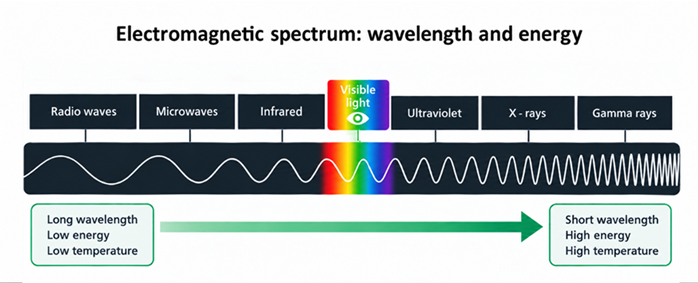
The cooler outer disc radiates mainly at longer wavelengths, such as infrared and visible light (Fig. 4). Closer to the black hole, matter moves faster, and the disc becomes hotter, shifting much of its radiation into the ultraviolet. In the innermost regions, plasma heated to millions of degrees can also produce X-rays. To telescopes, this combined radiation can outshine the hundreds of billions of stars in its host galaxy.
Dazzling end
Turbulence strips disc material of angular momentum, letting gravity pull it inward (Fig. 5). As matter spirals deeper into the gravitational well, its sideways velocity increases, with the innermost layers moving at a substantial fraction of the speed of light. Eventually, the plasma reaches a region where gravity becomes so strong that stable orbits can no longer be sustained. It then plunges toward the black hole while continuing to circle it, emitting a final, dazzling farewell. Once it crosses the event horizon, no signal can reach an outside observer or a telescope.

First observed in the 1960s, quasars are still a relatively recent astronomical discovery. Since then, they have transformed our understanding of the early universe's extreme physics. Yet many details of how accretion discs generate turbulence and convert gravitational energy into radiation remain under investigation. In that sense, quasars are more than distant beacons shining across the largely unexplored reaches of the universe. They are also beacons of discovery, illuminating new territory in physics and pointing toward knowledge that is still being developed.


Comments