

Do Mirrors Reverse Left and Right? Where Physics Meets Psychology

There is a common misconception that mirrors reverse sides. They do not, and this is easy to prove. Tie a ribbon on your left hand and look in the mirror. The ribbon stays on the left side, where your heart beats (Fig. 1). Yet even after this simple test, you will continue mistaking left for right when reversing your car. Why does our brain so stubbornly refuse to accept the fact? Is there something wrong with us, the mirrors, or our perception of reality?

Why symmetry tricks our brain
This confusion arises from a blend of all three factors, explaining why it is so difficult to shake off. Our bodies are bilaterally symmetrical, with the left and right sides looking quite similar. This design is prevalent among most living beings because it supports coordination and balance. Humans enhance this symmetry through their choices in hairstyles, clothing, and footwear. This is why an odd detail, like a bow, is sometimes needed to break the symmetry and reestablish the left-right distinction.
To help you break the spell, I will show how peculiar your reflection would appear if mirrors indeed reversed sides. I find proof by contradiction to be most effective in overcoming psychological bias. A hypothetical scenario where reflections reverse the left and right sides is illustrated in Fig. 2. Here, a character's right hand, which waves, becomes her left hand in the mirror, while her left foot with the pom-pom becomes her right foot. Is this what you really observe in the mirrors? Certainly not. Such a reflection, if it occurred, would freak you out.

Who reverses texts, you or the mirror?
That might be so, you think, but what about text? We all know that writing appears unreadable in a mirror. However, it isn’t the mirror that reverses the text; you do it yourself, and your brain is so caught up in this illusion that you don't even realize it. Take a sheet of paper with text and mark the left side with L and the right side with R. When you read the text, your left hand holds the side labeled L, and your right hand holds the side labeled R (Fig. 3). In this position, the mirror reflects the back of the paper, not the text itself.

To see the text in the mirror, you need to rotate the paper 180°. But in doing so, you also reverse its sides. Now your right hand holds the side labeled L, and your left hand holds the side labeled R (Fig. 4). Your own action caused the letters to appear in the wrong order. If the paper were transparent, however, you could see the text through it without turning it around (Fig. 5). In that case, the mirror would reflect the text in the correct order, allowing you to read it in the mirror and in your hands at the same time.
What mirrors actually reverse is front and back
We have established that mirrors do not switch sides. They also do not turn us upside down, which is quite obvious and doesn't need verification. What mirrors truly reverse is front and back. However, mirror reflections are so confusing that we often perceive this trait as an illusion rather than a fact. Therefore, before exploring the physical and psychological factors behind this phenomenon, we need to visualize what this reversal means in practical terms, using this simple example.
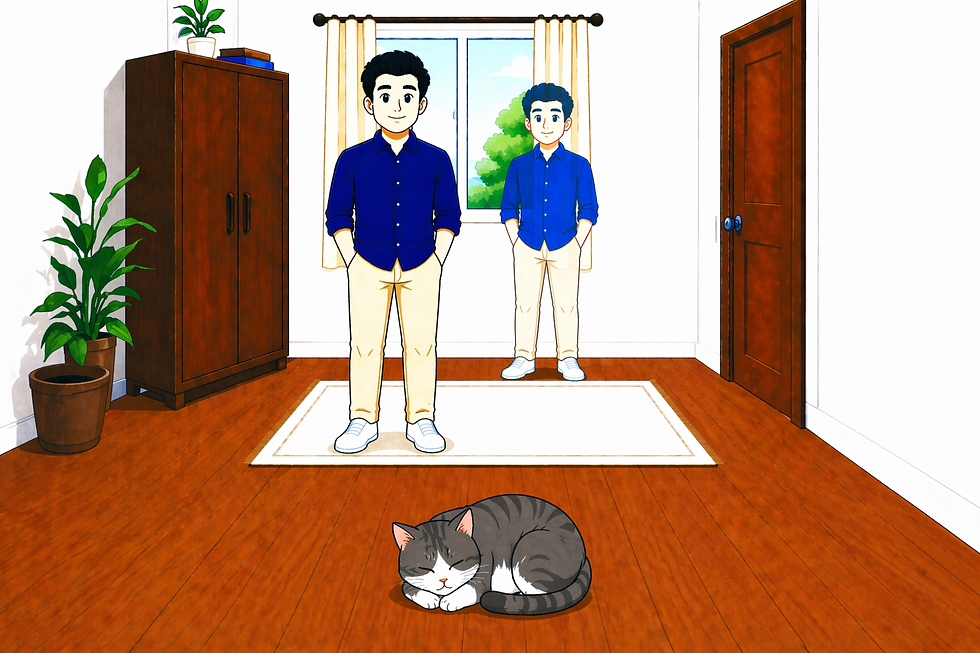
Imagine yourself standing in a room, with your double behind you (Fig. 6). You and the double share the same orientation in all three dimensions. To your left is a door, and to your right is a wardrobe. In terms of depth, a window is behind you both, and a cat is in front. Vertically, there is a ceiling above you and a floor below. This alignment in all three dimensions means that your double views you from behind. If your double were to step forward into your line of sight, you would see it from behind, too. And this is how you would see yourself in the mirror: from behind (Fig. 7).
When two people or objects are aligned front-to-back, the face-to-face view is impossible. If mirrors did not reverse the orientation of depth, we would see our backs instead of our faces. But mirrors display our front view. So, to associate ourselves with our double in the mirror and assume its position, we mentally rotate ourselves 180°. However, by doing so, we don't just swap our front and back, but also flip our right and left. We do it because we don't know of any other way of reaching our goal. In our world, it i s not possible to reverse only one orientation. But that is not how mirrors do it, which is why we experience mental confusion.

How mirrors form reflections
We see the objects around us because the light they reflect carries information about them. When light enters our eyes, it conveys this information to the photoreceptors in the retina, which then send it to the brain. Our perception of objects is largely influenced by how the brain interprets this information. For example, the brain determines an object's position based on the direction of light entering the eye. This process usually functions effectively, except when it comes to mirrors. This is why mirrors can be such effective tricksters.
The diagram in Fig. 8 illustrates how a mirror forms a reflection. A light ray originating from the ball positioned behind an observer hits the mirror and is reflected into the observer’s eye. At the point of incidence, the ray changes its direction, switching from approaching the mirror to moving away from it. The observer’s brain does not register the change in direction. Instead, it interprets the ray as if it had traveled in a straight line from behind the mirror, thereby forming a virtual image of the ball behind the mirror surface.
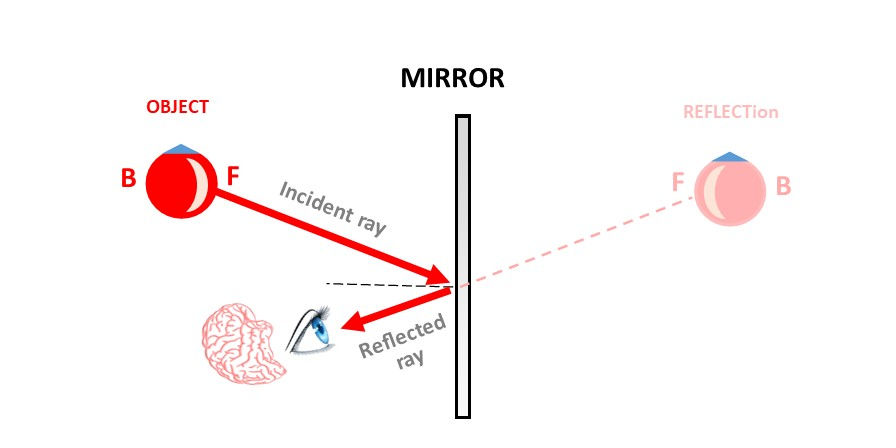
This virtual image looks nearly identical to the original, except it is located in front of the observer rather than behind, thus flipping the observer's perspective from back to front. However, unlike our double in the room, who we rotated previously, this image does not swap left and right. Physical objects can't undergo such a transformation. They aren't the phantoms existing only in the mind of an observer. As parts of the physical world, they must obey the geometric properties of space, meaning they can't reverse only one dimension; they must reverse two.
The geometry behind mirror reflections
For physical objects, including our bodies, reversing a single direction is physically impossible because they rotate about an axis, while the other two dimensions form a plane of rotation. Therefore, reversing the front–back direction necessarily involves reversing one additional orientation: either left–right or top–bottom. Our natural choice is the first option. When we turn around to see what's behind us, we rotate about the top-bottom (vertical) axis (Fig. 9, left), causing both front-back and left-right to switch simultaneously. This is a transformation the brain is familiar with.

The alternative would be to rotate about the left-right (horizontal) axis, which swaps front-back and top-bottom. While physically valid, this is not a choice our brain would make to form a helpful mental picture. We don't normally perform a somersault to look behind, so this option isn't supported by our normal daily experiences.
The mirror images, however, are not constrained by physical reality because they are not physical objects. As a result, they can reverse a single front–back direction without tagging in another one. To reconcile this unfamiliar transformation, our brain substitutes the closest familiar alternative: a turn around the vertical axis. This is why a mirror seems to reverse left and right, even though the mirror itself does not actually do it.
When reversing a car, we try to connect with the rear view, mentally adopting the perspective of our mirror image. But in mapping that view back to our own body, we instinctively apply the familiar left–right swap. With practice, experienced drivers learn to override this tendency and recognize the correct order. But even they might revert to the old habits if, for some reason, they stop driving for a while.
Inside a world of alternative mirrors
What would our lives be like had mirrors not switched front and back? Without this property, they would be almost useless. They could still show our backs or a partial profile, but never our faces. No matter how we moved, the mirror would keep our front out of view. The familiar experience of “meeting ourselves” would vanish entirely. Even a second mirror would not help: without front–back reversal, it would simply reproduce the same back view.

Without rear-view mirrors, driving would become extremely difficult, adding friction to everyday life. Yet this inconvenience is minor compared to the broader implications. A mirror’s ability to form images is inseparable from its ability to reflect light. If mirrors somehow lost this property, so would all other objects. Light would no longer be reflected toward our eyes, and vision itself would disappear. Fortunately, this scenario is impossible in a world governed by consistent physical laws.
This thought experiment highlights the actual nature of mirrors. They reverse front and back because light reverses its direction upon reflection: before hitting the mirror, light moves toward it; afterward, it moves away. The confusion occurs when the brain perceives this optical process as if the reflection were a real object turned around. However, a mirror does not reverse reality. It merely reverses the information carried by light from one direction to another.
.


Comments