

Can a mirror reflect the darkness?

Updated: Jan 22
Physics describes darkness as the absence of light. Since mirrors create images by reflecting light, the question essentially askswhether mirrors can reflect nothing. In a completely dark setting, that's precisely what they would do. However, total darkness doesn't exist in nature. On the darkest nights, some light from the Moon, the stars, or distant cities is always present. Even in the deepest caves or sealed underground chambers, traces of photons persist, and mirrors still reflect them. Yet, what we really want to know when we ask this question is what a mirror reflects when it shows black gaps within a lit image (Fig. 1).

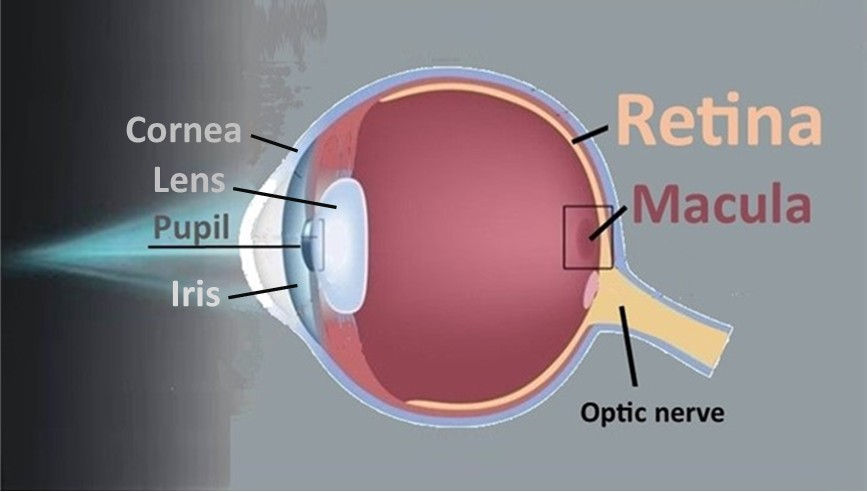
To understand how a mirror reflects, we must first grasp how our vision works. If you switch off the light in a room, everything immediately turns dark. You can no longer see walls, furniture, or even a mirror in front of you. For us to see an object, light must bounce off it into our eyes. At the back of your eye, there is a layer of thin tissue called the retina (Fig. 2), which contains photoreceptor cells that convert light into electrical signals. When those signals reach our brain, they are transformed into images of the objects. Without light, the photoreceptors in the retina remain inactive, and the brain receives no information, leading it to perceive the surroundings as a dark void.
When you turn on the light, you can see the walls and furniture because light acts as an intermediary between them and your eyes. As it hits objects, it collects information about shapes and colors, which it passes to your retina. The light's path can be direct or indirect, involving a mirror. In Fig. 3, a girl can't see her red ball directly because it is outside her line of sight. However, she can see it in a mirror because light reflects off the ball onto the mirror, then to her eyes. In the dark room, objects were invisible because, without light, there was nothing for them to reflect. The same principle applies to mirrors. When objects disappear from our view due to darkness, their reflections vanish as well.

Can a mirror reflect shadows?
A shadow is an area that receives less light because something blocks it. Consequently, it reflects less light toward a mirror. In the mirror, these areas appear dimmer and may even look black against very bright surroundings. Yet, any black patterns in reflections are a play of contrast. In Fig. 1, the background appears black because the foreground table is much brighter. Still, in a lit room, there can't be regions completely devoid of light. Without light at all, even shadows would disappear, as they would have nothing to contrast against.
Mirrors can't cheat physics. They possess no magical abilities and follow the same laws of optics as everything and everyone, including you and me. All that mirrors do is redirect the information about the surroundings back into our eyes, enabling us to see the object outside our line of sight. What we perceive as darkness is just a pattern of the light's uneven distribution. When an object is within our line of sight, this pattern is projected directly onto our retinas. If it's not, the information is projected onto the mirror, which merely reverses the light's direction toward us, while preserving all the vital information it carries.
So, can we say that a mirror reflects darkness?
As a metaphor, perhaps. Writers and poets often use expressions like "black shadows" or "mirrors of darkness" because literature seeks to evoke emotions and create vivid imagery. Science, on the other hand, values precision. In physics, darkness cannot reflect off a mirror and enter our eyes, triggering a reaction that only light can. Darkness signifies the absence of light, and even advanced high-quality mirrors can't reflect what doesn't exist. This simple truth underscores a significant point. Mirrors don't create reality; they are merely passive intermediaries in an exchange of information between an object and an observer. The crucial role is aligned with light. Without photons carrying the information, mirrors remain visually silent, just as we are without the illuminating power of light.




Comments