

Why does space look dark even though it is full of light?

On a clear day, the sky is bright, giving the impression that this illuminated space expands above the Earth for a very long distance. Yet if we were to rise through the atmosphere, the sky would grow darker with every kilometer and turn completely black when the last traces of air disappear. The Sun would still emit photons at the same rate as before. So, why does the vacuum look as though the light has been switched off? The explanation lies not in the light itself, but in how our vision operates. It only detects the light that reaches our eyes. The rays that miss our eyes remain invisible to us, as if they never existed at all.

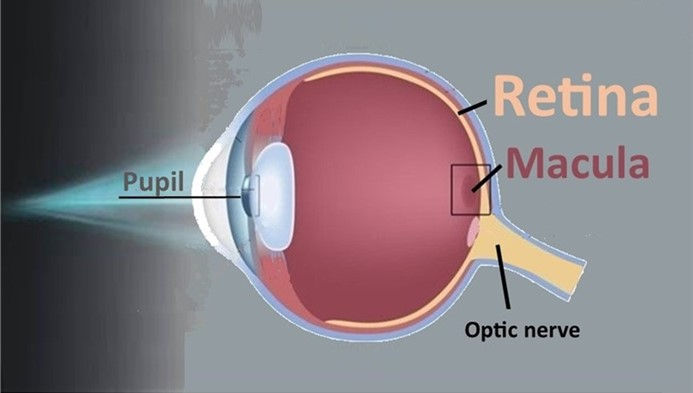
Light does not become visible simply by existing or by passing through a region of space. It manifests its presence only when it interacts with an observer or a detector. Our eyes are not passive windows into the universe but selective detectors. Of the countless light rays streaming past us at every moment, we perceive only a tiny fraction: those that happen to enter our pupils, strike the retina, and trigger the photoreceptors embedded within it (Fig. 2). All other rays, no matter how abundant or energetic, might as well not exist as far as our perception is concerned. In space, where there is nothing to scatter light into our eyes, most photons pass by unnoticed, leaving the cosmos looking dark despite being flooded with light.
Why does light flood the space yet leave it dark?
Light always travels in a straight line unless something is in the way that can scatter it and change its direction. In the vacuum of space, there is nothing to disrupt the photons' trajectory and redirect them toward our eyes. On Earth, however, light must pass through an atmosphere filled with gas molecules, tiny dust particles, and occasional moisture droplets. These constituents act as countless microscopic obstacles that interact with incoming photons, scattering them in all directions, including toward our eyes. The sky appears bright because the atmosphere feeds light into our line of sight.
As you ascend higher into the atmosphere, the air becomes thinner. With fewer molecules remaining, fewer photons are scattered in our direction and captured by our eyes. With altitude, therefore, the sky grows darker. Beyond the atmosphere, scattering effectively stops altogether. Sunlight still streams through space in immense quantities, but unless we look directly at the Sun or at an object reflecting its light, those photons pass by unnoticed. This is why Earth's atmosphere makes the sky glow, while space itself appears black.
Paradoxical as it may seem, we see only the light that happens to land on the tiny receptive surfaces of our eyes. The same principle applies to photosensitive equipment, including cameras, telescopes, and space-based observatories. Telescopes do not make space brighter; they merely collect more photons from a given direction and concentrate them onto a detector. By capturing light that would otherwise miss us entirely, they reveal faint stars, distant galaxies, and subtle cosmic structures that are always there but remain invisible until their light is intercepted and directed to an observing device
Why would strictly radial light shrink the Sun to a dot?
We would even see the Sun as an infinitesimal dot if the emitted light were perfectly radial (Fig.3, left). What allows us to perceive the Sun's real size and shape is that it emits diffuse (Fig. 3, right), rather than purely radial light. Diffuse emission plays a crucial role in how stars and galaxies appear to us. Imagine the Sun were a perfectly spherical, uniform ball whose surface emitted photons strictly in the radial direction, with no angular spread. All photons then would travel straight outward from the Sun's center, diverging as they move through space.
In such a scenario, the geometry of space would severely limit the number of photons reaching our eyes, especially given the Earth's distance from the Sun. Only those photons emitted along the one narrow set of directions that line up precisely with our pupils would interact with our photoreceptors and report to our brain about their existence. That bundle of directions is vanishingly small. Almost all photons, even those passing very close to us, would miss us entirely. To us, the Sun would collapse into a single point, conveying no information about its actual size and structure.

Diffuse emission and the origin of astronomical images
However, this idealized picture of flawless bodies does not describe reality. Perfect directional symmetry does not exist in nature. The Sun is made of atoms in constant thermal motion. Its surface, known as the photosphere, is a churning plasma riddled with convection, turbulence, magnetic fields, and temperature fluctuations. At the microscopic level, symmetry is continuously broken, preventing light from being confined to perfectly radial directions. Instead, each tiny area of the Sun's surface emits photons over a range of angles. The result is diffuse emission.
This angular spread allows light from various parts of the Sun's surface converge onto the pupils. Light rays arriving from different directions are mapped onto different parts of the retina, producing a circular image rather than a dot. The Sun appears as a disk because diffuse emission retains geometric information about where that light came from. Symmetry would erase the information about the Sun's shape and chemical composition. It is the imperfections of nature, resulting from motion, interaction, and disorder at microscopic scales, that give light its diffuse character and allow us to observe the universe and explore its formations.
The darkness of space is not a failure of the universe to shine; it's a consequence of how light travels and how vision works. Light doesn't manifest its presence by mere passing through space. It must be intercepted, redirected, and registered by a detector. On Earth, the atmosphere performs this task for us, scattering sunlight into our line of sight and making the sky glow. In the vacuum of space, where such scattering is absent, most photons pass by unseen.
If light were emitted only along perfectly radial directions, all stars would appear as featureless points, their size and structure erased from perception. What rescues the visible universe from this fate is diffuse emission: the inevitable angular dispersion caused by the inherent activity of matter. Because each small area of a star’s surface emits light in multiple directions, geometric information is preserved. This gives light the freedom to carry that information across space and imprint it on our retinas and other photoreceptive detectors.





Wow