

Formation of the Solar System: From Dust to Starlight and Planets

Updated: Aug 3
When we think of the Solar System, we usually picture a tidy sequence of eight planets extending out from the Sun. But the Solar System isn’t just arranged in space; it is also shaped by history. Within it lie bookmarks that tell the story of how the Sun and planets evolved from the primordial solar nebula. By closely examining these clues, we can reveal the different stages, influenced by shifts in temperature, materials, and dynamics, and understand why our Solar System looks as it does today.

From nebula to star
The widely accepted nebular hypothesis suggests that our Solar System originated from a gas and dust cloud, called a solar nebula, about 4.6 billion years ago. This huge cloud was drifting through space until it was disturbed, possibly by a passing star or a supernova shock wave. This disruption initiated a gravitational collapse, causing material to fall inward. As the cloud contracted, conservation of angular momentum flattened it into a rotating disk, with a proto-Sun emerging at the center (Fig. 2).

As contraction continued, pressure and temperature inside the proto-Sun increased. Once conditions crossed a critical threshold, nuclear fusion commenced, igniting a new shining star. The remaining gas and dust surrounding the young Sun formed a protoplanetary disk. Within this disk, microscopic dust grains collided and coalesced into pebbles. Over time, pebbles grew into kilometer-sized planetesimals, from which protoplanets and, eventually, planets emerged.
Why are the inner planets small and rocky?
The Solar System's eight planets naturally fall into two groups. The first group consists of the four small, rocky planets: Mercury, Venus, Earth, and Mars, which are located near the Sun. The second group includes the four gas and ice giants: Jupiter, Saturn, Uranus, and Neptune, which are positioned farther away, completing the planetary lineup (Fig. 3). This sharp division is one of the most important clues to the conditions that prevailed in the early Solar System.

The split is not coincidental. It stems from temperature and timing within the protoplanetary disk. The solar nebula was mainly composed of gas, such as hydrogen and helium, with a small amount of dust. . Near the Sun, the extreme heat caused volatile compounds like water, methane, and ammonia to vaporize. The solar wind dispersed gas. The remaining dust formed four rocky planets. However, the proportion of dust to gas was so small that these planets, even combined, make up only 1% of Jupiter's mass.
Farther from the Sun, conditions were different. Beyond a critical distance, known as the frost line (Fig. 2), temperatures dropped enough for water and other volatiles to freeze. Ice mixed with dust provided excellent and plentiful building material. In this environment, the planets grew rapidly, becoming massive enough to capture gas before the solar wind blew it away.
Gas and ice giants
The timing was the key. Gas in the disk lasted for only a few million years, a short period in geological terms. Jupiter and Saturn were situated near the frost line, where ice was more abundant. They accumulated enough mass early on to capture a significant amount of gas before the solar wind blew it out of the Solar System. Consequently, they ended up with thick layers of hydrogen and helium around their icy cores, transforming them into gas giants.
Uranus and Neptune formed at a slower pace because the density of ice in the disk decreases with distance. This delay in development meant they missed the chance to join in the active phase of gas accretion, when gas rapidly collapses onto the core. As a result, they have much thinner layers of hydrogen and helium. With their icy cores being the dominant feature, they are classified as ice giants.
Asteroid Belt
While the inner planets were still forming, the massive Jupiter started interfering with the orbits of nearby planetesimals, preventing them from merging. Early models suggest that, left to their own, these planetesimals might have produced a planet several times the mass of Earth. Jupiter didn’t allow this. With collisions becoming more destructive than constructive, the planetesimals were smashed, and their growth was stalled.
These rocky and metallic bodies make up the Asteroid Belt, which lies between Mars and Jupiter (Fig. 3). Most are relatively small, although some are much larger, including Ceres, which is classified as a dwarf planet. Though asteroids in the belt are widely dispersed, collisions can still occur, sometimes sending objects into new orbits. Most asteroids that enter near-Earth space originate in the Asteroid Belt, including the object believed to have caused the Tunguska event in 1908.

Kuiper Belt
The Kuiper belt serves as another bookmark in the history of the Solar System. Situated beyond Neptune, it defines the outer boundary of the planetary system. In contrast to the Asteroid belt, which contains rocky debris from areas near the Sun, the Kuiper belt is made up of icy material that originated beyond the frost line. Consequently, the objects in the Kuiper Belt tend to be larger. If Ceres measures about 940 km across, then Pluto in the Kuiper belt is about 2,377 km across.
During the chaotic formation stage, Jupiter's enormous gravity caused the gas and ice giants to shift their positions. These migrations played havoc with the orbits of planetesimals. Some were sent inward, possibly delivering water and other volatiles to Earth; others were either pushed into distant orbits or ejected from the Solar System entirely. Those retained by Neptune's gravitational influence formed the Kuiper belt. Even today, Jupiter continues to affect the trajectories of asteroids, absorbing some and steering others away from Earth.
Oort Cloud
Far beyond the Kuiper belt lies the final frontier of the Solar System, the Oort cloud. Unlike the flattened Asteroid and Kuiper belts, the Oort cloud forms a vast spherical halo around the Sun and the planetary system. Its shape suggests it was never part of the protoplanetary disk. Instead, its icy bodies originated within the region of giant planets, but were ejected from there by Jupiter and retained by the Sun at the edge of its gravitational influence.
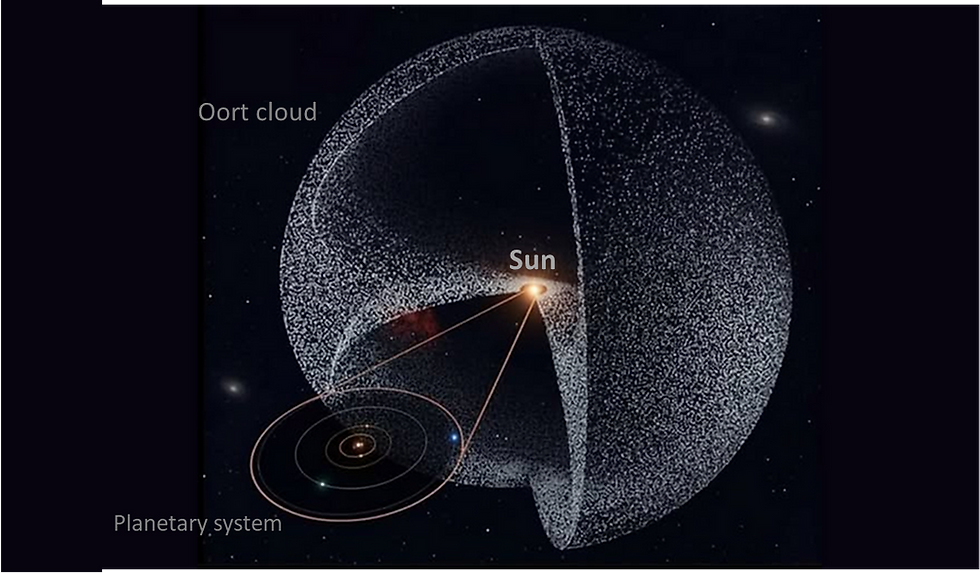
Loosely bound to the Sun, the Oort cloud extends almost halfway to the nearest stars. Over time, galactic tidal forces and perturbations from passing stars reshaped its elongated orbits into a roughly spherical distribution. Due to its remoteness and darkness, the Oort cloud is shrouded in mystery. Long-period comets are its only visible messengers, making repeated visits every 30 million years or so, reminding us of how vast the Solar System is and of the violent events that shaped it.


Comments