

A reflection rainbow that doesn’t reflect reality: examining a viral video

Updated: Mar 10
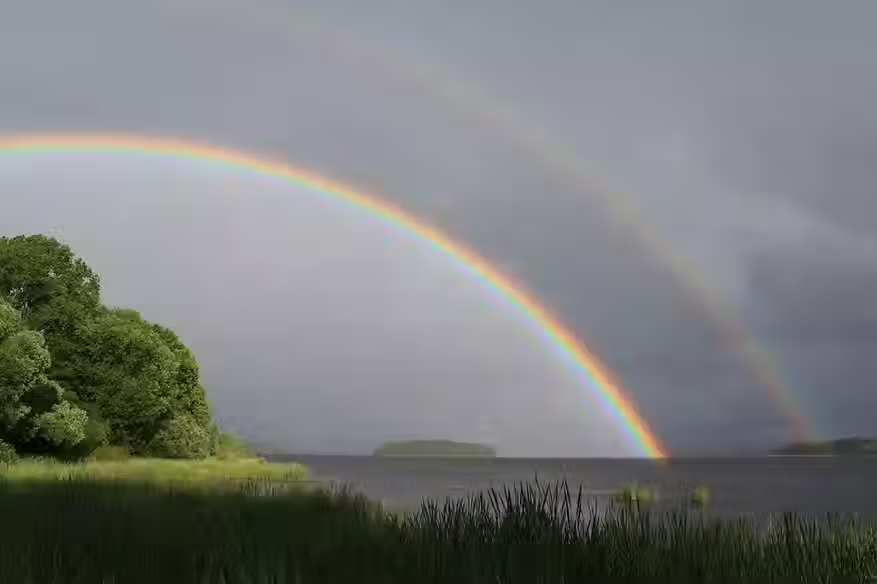
The video in Fig. 1 offers a perfect opportunity to explain how real rainbows behave and how editing can manipulate the laws of physics. At first glance, the image appears to show a spectacular display of multiple rainbows. The rainbow on the left looks physically consistent and sets the expectation of realism. However, a closer examination of the intersecting arcs raises strong suspicions. Is this video authentic? Let’s apply basic optics to find out

When rainbows behave as nature intended
Rainbows appear under specific conditions: the Sun must be behind the observer, with raindrops in front. Sunlight enters each raindrop, refracts at the surface, reflects internally, and refracts again as it exits. These optical processes produce several recognizable features. Rays undergoing a single internal reflection form the primary rainbow (Fig. 2, left). Its colour order is fixed: red on the outside and violet on the inside. The rays undergoing two internal reflections form the secondary rainbow (Fig. 2, right). The additional reflection reverses the color order, with red inside and violet outside, and reduces color brightness.

Thus, the primary arc appears brighter, and the secondary arc above the primary is either fainter or not visible at all. The laws of optics also expect the inner section of the primary arc to be lighter than the sky around it (Fig. 3), whereas the sector above, known as Alexander’s band, appears darker. The left rainbow in the video aligns well with these expectations: correct colour sequence, realistic brightness, and a weaker secondary arc. So far, everything related to that particular rainbow checks out.
The "extra rainbow" that makes no sense
Look at the three arcs on the right side of the video, which intersect the arcs of the main rainbow. This is where physics begins to raise an eyebrow. In principle, the presence of a second rainbow beside the main one is possible. This rare atmospheric phenomenon, called a reflection rainbow (Fig. 4), occurs when sunlight reflected from a wet surface, such as a road or nearby reservoir, acts as a secondary light source, effectively creating a “virtual Sun” that produces its own rainbow. However, because the “virtual Sun” has a different location, the resulting bow would not appear as a simple duplicate of the main rainbow, nor would it produce perfectly symmetric intersection patterns.

Let us ignore, for the moment, the third, lower arc in the video, which should not be present at all because it violates the angular geometry governing rainbow formation, specifically, the ~42° radius characteristic of the primary bow. Focusing instead on the two upper arcs of the “extra rainbow,” we find that they closely resemble a shifted copy of the genuine rainbow on the left.
To understand why this is suspicious, we need to consider the angular geometry of rainbows. Every rainbow is centred on its own antisolar point, which is the point directly opposite the light source as seen by an observer (Fig. 5). A conventional rainbow is centred opposite the real Sun, whereas a reflection rainbow would be centred opposite the virtual Sun created by reflection in water. Because the real and virtual Suns occupy different positions, the corresponding rainbows must have different centres and therefore different orientations and curvature, as shown in Fig. 4.

This has an important consequence: the second rainbow cannot appear as a parallel duplicate of the first. Instead, its arc must diverge geometrically, reflecting the different directions of the incoming rays. When two bows appear geometrically identical, maintaining constant spacing and forming symmetric shapes where they overlap, this suggests that they share the same centre, which would only occur if one were a duplicated image rather than an independent optical phenomenon.
For an observer to see two genuine bows simultaneously, the light rays responsible for each must arrive from different directions and converge at the eye. Identical geometry implies identical viewing directions, which is inconsistent with two separate light sources. A rainbow is not a physical object fixed at a particular location in the sky, but a viewing geometry defined by the observer’s position. Each observer sees their own rainbow, centred on their own antisolar point. A rainbow geometrically identical to yours could only be seen by someone standing very close to you, not by you as an additional, independent bow.

The geometric symmetry of the second rainbow clearly shows that the principles of perspective have been violated. Rather than exhibiting two physically independent bows formed by different light sources, the extra arcs behave like a shifted replica of the original. This second "rainbow" cannot be the result of an independent atmospheric phenomenon. The duplication effect results from either a reflection in the windshield or the superimposition of one image over another during editing.


Comments